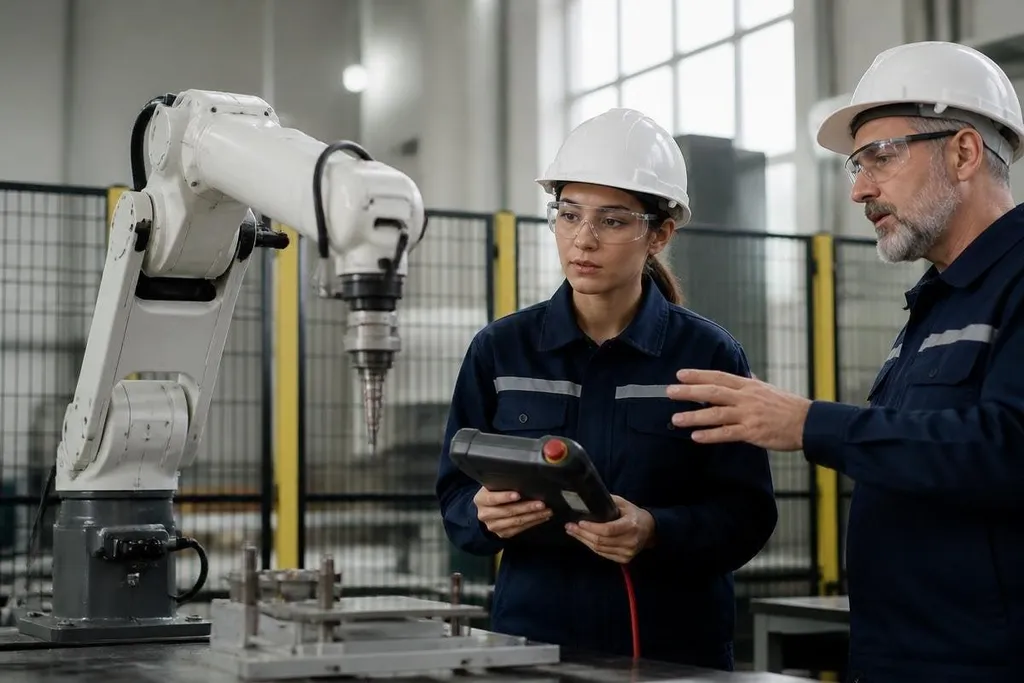
A training robot can repeat the same task, change one detail, and wait for the worker to try again. That makes it useful for jobs where mistakes cost time, damage equipment, or put people near moving parts.
The open question is whether companies can turn that repeatability into better workplace learning. Without a supplied evidence pack, this article focuses on how the method could work, where it may help, and what still needs proof.
- Repeatable practice without stopping a live production line
- Feedback tied to a worker’s actual movements
- A need for human instruction, careful safety checks, and clear results
What a training robot would do
The robot could act as a physical practice partner. A new worker might learn to guide a mobile robot, load parts into a machine, inspect a package, or recover from a planned fault.
The training system would set the task, watch the attempt, and offer the next step. A robot can also change the task after each attempt.
It might place an object in a new position, alter the route, or add a time limit. The worker then practises the rule behind the task instead of memorising one fixed sequence.
That matters because many jobs contain small changes. A box may arrive at an angle. A sensor may stop responding. A person may need to move away from a robot before the system can restart. Training that includes these cases can make the lesson closer to the work people will face.
The robot doesn’t need to act like a human teacher. A clear prompt, a safe stop, and a record of each attempt may be enough for a narrow skill. A trainer can then spend their time on judgment, questions, and the parts of the job that a machine can’t assess well.
Feedback needs to explain the mistake
A score alone won’t teach much. The worker needs to know what happened and what to try next. If a hand entered a marked safety zone, the system should show that moment and explain the rule in plain words.
The same record could help a supervisor spot a shared problem. If several workers pause before a handoff, the lesson may need a clearer step or a better practice object. That points to a change in the training material, not a label placed on the worker.
The feedback must fit the task. A robot measuring position may help with a pick-and-place exercise. It may say little about how a worker handles a tense conversation, notices a damaged part, or asks for help. Those skills need a person, a role-play, or another form of review.
A workplace training demo needs the task, date, score, and human review named beside it. Dated workplace robotics reporting can show whether the system supports a real lesson or measures only a narrow drill. That record sets up the limits of the method.
Where the method can fail
Training robots can repeat an exercise, but repetition alone doesn’t prove learning. A worker may perform well in the practice room and still struggle beside a loud machine, under shift pressure, or with a task the system never included.
The training data also needs care. A system that marks every pause as an error may punish safe behavior. A worker who takes extra time to check a load could receive a lower score than someone who moves faster and misses a hazard.
Cost and upkeep matter too. Someone must write the lessons, inspect the robot, update the task after a process change, and review records. If the system takes more work to maintain than the old lesson, the robot may add expense without helping the team.
Privacy needs a clear rule. Movement records can show how a person works, so the company should state what it stores, who can view it, and how long it stays available. Training data should help fix lessons before it becomes a hidden performance file.
I’d use a training robot first for repeatable physical tasks with clear safety rules, then compare its results with instructor-led practice.
A buying and trial checklist
Before a workplace trial, check these points:
- Name the skill: Write down the task the worker should perform after training.
- Set the safe limit: Define the robot’s speed, force, work area, and stop method.
- Record the baseline: Measure how people perform before the robot enters the lesson.
- Test changed cases: Add new object positions, routes, or fault conditions.
- Keep human review: Let a trainer inspect mistakes the robot cannot judge.
- Choose the result: Decide which work measure will show whether the lesson helped.
That last point keeps the trial tied to work rather than a polished demonstration. The company could measure correct task completion, safe recovery from faults, or the time needed before a worker can practise without close help.
The next step is a small trial with one task, one trained group, and a result chosen in advance. Until that comparison is made, a training robot is a promising teaching tool, not proof that workplace learning has improved.